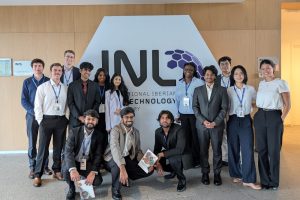
MSEM students have just returned to campus after spending most of January in Europe. They were participating in the immersion program, in which they completed consulting projects with startup companies and multinational conglomerates.
The program allows students the opportunity to apply their engineering mindsets to business problems, work in multidisciplinary and multicultural teams, and learn more about business cultures and economies outside the US. During the immersion program, students also have free time to tour historic cities, visit museums, and enjoy local delicacies.
The program places students in one of four international locations: Braga, Portugal to work with researchers at the Iberian Nanotechnology Laboratory (INL); Coimbra, Portugal to work with entrepreneurs at the Instituto Pedro Nunes (IPN); Cuenca, Spain to work with entrepreneurs at the Urban Forest Innovation Lab; and Copenhagen, Denmark to work with students at the Technical University of Denmark (DTU) on consulting projects for Siemens. Students can also choose to stay local and complete projects in Baltimore, with a weekend trip full of site visits and cultural experiences in New York.
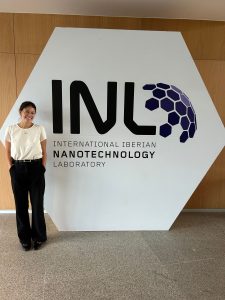
Elle at the Iberian Nanotechnology Laboratory.
We spoke with Elle Marine, an MSEM student pursuing the innovation and multidisciplinary design track, about her experience working at the INL in Braga, where students collaborate with researchers to commercialize the nanotechnologies created in their labs.
Elle’s team worked with researchers at INL who were developing methods to reduce battery degradation and shortage. The researchers focused on improving the battery’s separator, the porous material between anodes and cathodes, which prevents them from colliding. Dendrites, branch-like growths that may develop on a battery’s anode during charging, often puncture the separator, causing batteries to short circuit, overheat, or even catch fire and explode, depending on the type of battery.
The researchers explored methods to fortify the separator. “They modif[ied] the typical material for the separator and impregnat[ed] it with nanoparticles. The team has done some initial testing with the separator, and it has shown improvements in many metrics surrounding battery performance, including safety margins and cycle life,” Elle said.
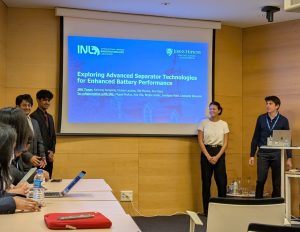
Elle and her team presenting to their project partners at the Iberian Nanotechnology Laboratory.
When Elle’s team arrived at the INL, they met with the researchers to learn about the technology behind their modified separator and then provided recommendations on where this separator technology could be implemented. “This involved identifying the power-source [the modified separator] goes into, whether that’s a battery or a capacitor or a supercapacitor, and then identifying markets in which improvements from their separator are highly-desirable. Additionally, we provided recommendations and considerations when it came to regulatory and manufacturing factors,” Elle said.
Beyond her work at the INL, Elle enjoyed visiting several cities in Portugal during the program. “In particular, I liked Porto. They have beautiful architecture and a culture where people were often out grabbing coffee, drinks, or food together. My favorite memories were doing this with my classmates,” she said.
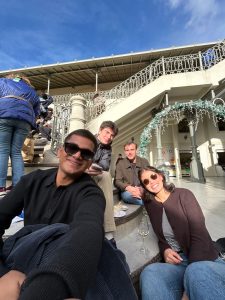
Elle and classmates at Vinos Artesanos Altomira, a winery in Mazarulleque, Spain.
Students in Cuenca enjoyed a private tour of the Prado Museum and the historic area of Cuenca, as well as an excursion to a winery in the Altomira valley and the Archaeological Park of Segóbriga. In Portugal, the teams in Coimbra and Braga united in Porto for a tour of the city and indulgent Francesinha sandwiches, and those in Denmark enjoyed a boat tour of the city, an excursion to Helsingor, and a site tour of the Ramboll offices. Students in Baltimore visited New York for the weekend to tour the Museum of Modern Art, attend a happy hour with MSEM alumni, and complete site visits to companies including Bloomberg.
In Cuenca, students worked with startup founders at the Urban Forest Innovation Lab, whose mission is to enhance Cuenca’s economy and environmental management by establishing an innovative forest business industry that capitalizes on sustainable forest exploitation. MSEM student Kshitij Rai and his team consulted for a sustainable housing venture at the UFIL. “I felt trusted from the start, knowing my decisions were shaping the company’s path forward. Seeing real growth emerge from those choices made the experience deeply meaningful. Living and working in Cuenca, a small historic town in Spain surrounded by cliffs and timeless architecture, added a quiet beauty and perspective to each day. The immersion was truly life-changing, shaping how I think about engineering management. Experiences like this reflect the value of immersive, real-world learning that remains relevant long after it ends,” he said.
For more photos of our students’ experiences abroad, visit us on Instagram.