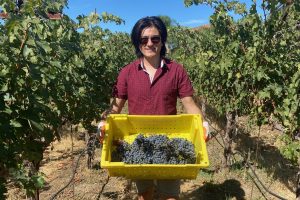
Tyler Spoleti has been on the cutting-edge of autonomous product design since graduating from the Johns Hopkins MS in Engineering Management program in 2021. Between working on the team that delivered the first autonomous tractor to market and his current role at Agility Robotics, he focuses on addressing issues of sustainability, mitigating labor shortages, and providing opportunities for employees to focus on higher value tasks. We spoke with him to learn more about his career as a product manager and how MSEM prepared him for this role.
Why did you pursue an MSEM degree?
The MSEM degree helped me explore technology in a human-centered and holistic way. While studying mechanical engineering as an undergraduate, I often found myself gravitating towards the “why” that motivated new innovations instead of the how behind their inner workings. I wanted to develop this interest and saw a strong fit with MSEM’s focus on technology strategy and design thinking. The emphasis on project-based coursework was also enticing because I could refine my collaboration skills and ability to rapidly ideate.
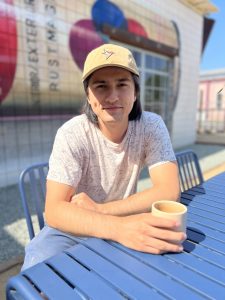
Tyler Spoleti in San Diego, CA.
What is your most memorable moment from the MSEM program?
As part of the Strategies of Innovation & Growth course, I had the opportunity to develop marketing strategies for the Maryland Craft Brewing Association. It was exciting to study an industry that balances business viability with an artisanal practice. Of course, the highlight was visiting Baltimore breweries to dig into their challenges beyond brewing like label design, distribution, and adoption. We also ran an online consumer survey that caught on within a few Maryland groups and received over 750 responses. It was fun to experience the vibrancy of the community and back-up our project recommendations with that mini virality. As a mechanical engineer by training, I would have never anticipated getting to investigate this problem space. This project becoming part of my Johns Hopkins education still amazes me.
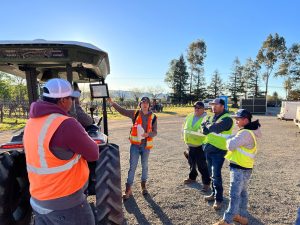
Tyler giving a product overview of the “pilot series” Monarch Tractor to drivers at a Napa Valley vineyard.
Can you tell us more about your time at Monarch Tractor developing an electric, autonomous tractor?
After graduating from MSEM, I moved to the Bay Area to work at Monarch Tractor, and it was an awesome adventure. I was part of the team that launched the world’s first electric, driver-optional tractor to address issues in agriculture sustainability and labor availability. As a product manager, I primarily shaped product features for the vehicle operation experience and fleet management software. A lot of the challenges we faced centered around deploying new technology in a relatively risk-averse industry. To overcome this, I liked spending time on our customers’ farms. I appreciated making contributions to our food system and learning about everything that goes into running it. I had a lot of unique life experiences like observing wine grape harvest operations at midnight and presenting our product suite at the Washington-Oregon Potato Conference.
In your current role at Agility Robotics, what product(s) are you developing? What most excites you about this new role?
Agility Robotics is the first company to commercially sell and deploy humanoid robots. Our robots alleviate labor shortage challenges by taking on dull and dirty work in industrial settings such as warehouses. Although these environments have automated machinery, people are still needed to link or tend to these “islands of automation,” but in the United States, there are over one million unfilled jobs in the logistics space. As a product manager focused on our robot and its accessories, I define products that combine hardware and software for daily robot operation, safe human-robot interaction, and robot service & maintenance. I’m most excited about further defining how this promising innovation is applied practically so that it becomes a commonplace product. There is still so much potential for robots to help people focus on higher value or more creative tasks.
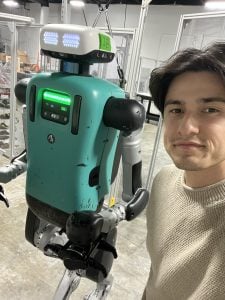
Tyler at Agility Robotics.
How did the MSEM program prepare you for your career?
As a product manager, I’ve collaborated with co-workers and customers with a wide variety of backgrounds. MSEM’s focus on professional communications refined my ability to articulate ideas to both technical and non-technical audiences. The memo writing and presentation exercises were particularly valuable in practicing how to convey complicated topics. In the MSEM program, I also regularly worked with peers from different engineering disciplines and global cultures. This improved how I evaluate ideas from multiple perspectives which is critical for my highly cross-functional role.
Why would you recommend the MSEM program?
The MSEM Program has engineers interact with technology in a completely different way from their previous backgrounds. You get to experience what it’s like to be at the intersection of business and engineering development. That’s invaluable for those interested in connecting the dots between people, technology, and our world.