
Aditya Prakash is a second-year MSEM student in the innovation and multidisciplinary design track. He is currently completing a full-time corporate strategy internship at Cummins, a company that designs and manufactures diesel and alternative fuel engines, generators, and related components. We caught up with Aditya to learn more about his experience at Cummins and his goals after graduation.
What are your responsibilities at Cummins and what kind of projects have you worked on in this role?
My work spanned multiple strategic initiatives across the business, including:
-
Enterprise AI integration: Assessed opportunities to integrate AI across functions, helped identify high-impact use cases, and supported early-stage alignment on adoption priorities.
-
Forecasting and portfolio planning: Built custom forecasting frameworks for the Battery and Powertrain portfolios, integrating demand modeling, FP&A inputs, and inventory considerations to improve planning accuracy and strengthen aftermarket decision-making.
-
Service strategy and operational performance: Defined service strategies across product lines in collaboration with cross-functional stakeholders, with a focus on reducing emergency orders, improving delivery reliability, and unlocking working-capital savings.
-
Pricing and go-to-market strategy: Contributed to pricing strategy and path-to-market recommendations for select products, balancing competitive dynamics, customer value, and internal financial objectives.
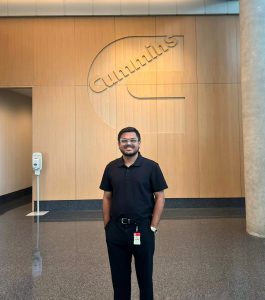
Aditya at his internship in the Cummins offices in Indianapolis, IN.
How has what you learned in the MSEM program contributed to your success in the role?
The MSEM program directly strengthened how I operate in an executive-facing strategy environment. The Professional Presentations course with Andy Ross improved my ability to build clear, executive-ready narratives, focusing on audience, structure, and decision-oriented communication, so my updates and recommendations were both concise and actionable. In addition, the Fundamentals of Product Management course with JJ Rorie sharpened my product thinking and customer-first approach, which was valuable even within a strategy role, especially when evaluating trade-offs, defining problem statements, and translating insights into practical roadmaps.
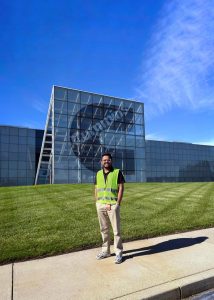
Aditya outside the Cummins plant in Columbus, IN.
What is the most valuable lesson you have learned throughout your internship experience?
The most valuable lesson was learning how to turn ambiguity into momentum. In corporate strategy, the “right” answer is rarely obvious at the start, so progress depends on defining the problem clearly, grounding decisions in data, and aligning stakeholders around a direction. I learned to synthesize inputs from finance, engineering, and operations into a single narrative, make trade-offs explicit, and deliver recommendations that teams can execute, while staying flexible as new information emerges.
What are your goals once you leave the MSEM program, professionally or otherwise?
After MSEM, I want to build my career at the intersection of technology and business, ideally in product or strategy roles at a technology-driven company. I’m most motivated by solving complex problems that require structured thinking, strong collaboration, and a deep understanding of how products and systems create value. Long term, I want to take on roles where I can own outcomes end-to-end, from defining the opportunity to driving execution and measurable impact.
If your organization is recruiting for internship positions and you would like to hire a current MSEM student, we welcome you to email us at cle@jhu.edu.